SHE selected as a Dining for Women Grant Recipient

We are proud to announce that SHE has been selected by Dining for Women as its February 2015 grant recipient!

Dining for Women logo changing the world tagline

Dining for Women is a non-profit giving circle dedicated to empowering women and girls living in extreme poverty.Its members “dine in” together once a month, each bringing a dish to share, and send out “dining out” dollars to international programs empowering women. Through its members’ combined dinner donations, Dining for Women supports grass-roots programs for women fostering good health, education, vocational training, micro-credit loans and economic development.

For more information, visit www.diningforwomen.org.

Why we’re grateful for YOU this Thanksgiving

We’re feeling extra thankful today, and it’s not just because it’s Thanksgiving today. We are producing 500 SHE LaunchPads a day at our Ngoma production site, and hundreds of girls and women are using our product for the first time. We’ve come far since when we started just 6 years ago, and it’s only because of you.

So in honor of your incredible commitment to our mission and our work, we wanted to share a few reasons why we’re thankful for YOU:

A few reasons why we're thankful for your generous support this year

A few reasons why we’re thankful for your generous support this year

On behalf of everyone at SHE and those who are benefitting from our game changing business and taboo-busting health education that you support in Rwanda, murakoze cyane, or thank you!

Board Member Jean Nganji Visits our Production Site in Rwanda

Screen Shot 2014-11-17 at 11.19.33 AM
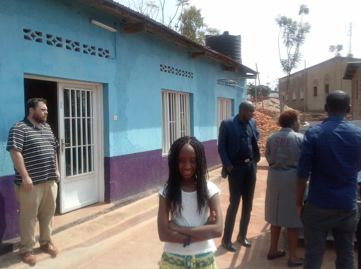
I just got back from Rwanda where I had the privilege to visit SHE factory in Ngoma Eastern Province of Rwanda. It was a particularly personal visit because I went there with my daughter, who is 11 now.

I left Kigali with Daniel Karemera, the site production manager. I was struck by the fact that almost everyone who works for SHE is very young, maybe the average age is 25.

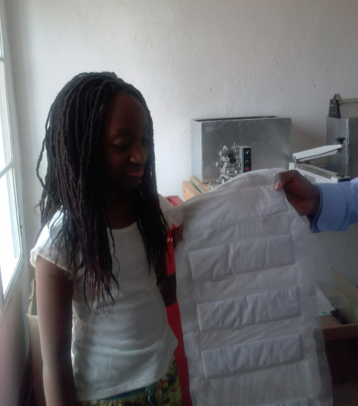
The trip is about two hours from Kigali the capital. At SHE, we were greeted by the production lead, Marie Umulisa and a chemical engineer from North Carolina, Tyson Huffman. Immediately, Ms. Umulisa walked us through the process of making the pads.Screen Shot 2014-11-17 at 11.19.21 AM

My first reaction when I arrived at the site was of a surprise. I was expecting a large factory, but what I saw instead was a simple building that looked like a store or school. However, as the team went on with the tour of the production site and I saw the final product, I realized that this factory is more like Microsoft’s humble beginnings in a garage. I am even more proud of Elizabeth and the SHE team, for having achieved this much out of nothing.

Meet SHE Intern: Sara Rossi

Sara Rossi photo

Hometown:  I’ve spent 5-7 years in each of the following places: Paris, France (where I was born), Connecticut, Texas, and California (San Francisco and LA) – so I never know how to answer this question!  I moved to New York City two years ago to pursue my MPH and MPA at Columbia University’s Mailman School of Public Health and SIPA, respectively.  I now live in Crown Heights, Brooklyn and will be graduating in December.

What are you working on?  This fall I will be working on several projects for the SHE team focusing on government advocacy, content development, strategy, and technology.  I’m looking forward to applying my public health, development, and gender expertise to furthering SHE’s mission!

What superpower would you have?  Teleporting.  I live an hour’s train ride from school and work – how nice it would be to be able to snap my fingers and arrive at my destination!  Either that or the ability to be two places at once, as my family lives in the UK and I have friends scattered around the globe.

What is your favorite flavor of ice cream?  I love fruity sorbets, salted caramel, and sometimes just a plain old vanilla cone from one of NYC’s ubiquitous ice cream trucks.

What was the last song that played on your iPod/iPhone/iPad?  Last night I was listening to the new self-titled album from indie folk/electro-pop band Sylvan Esso.

Why did you join SHE? I joined the SHE team to help unleash girls’ and women’s full potential by improving their health, promoting their dignity, and enabling their full participation in society.  I recently concluded a 6-month consulting engagement with BRAC on their Empowerment and Livelihoods for Adolescents program, which brought me to Uganda for 3 weeks of qualitative research.  There I met the most inspiring girls who face extremely challenging circumstances but have hope for their futures and take pride in themselves and their communities. One observation that struck me as a public health professional was the lack of affordable health commodities including sanitary pads.  Most girls used rags or other workarounds and suffered humiliation during that time of the month, as well as uncertainty due to lack of accurate menstrual health information.  I have been interested in social enterprise and market-based approaches to public health for the past couple of years am so excited to be a part of the path breaking work being done at SHE using these strategies to solve a fundamental public health problem.

Meet SHE Intern: Arianna Strome

nyu_vertstd_Arianna Strome-1

Hometown: I am originally from Baltimore, Maryland but currently I am attending New York University. I am a junior studying Media, Culture and Communications combined with Public Health.

What are you working on? I am helping the SHE team with marketing and social media.

What superpower would you have? If I could have any superpower it would be to have an incredible memory so that I could remember everything forever. Not only would this really help ace my midterms, I would be able to remember all the incredible people, experiences, conversations, and moments for the rest of my life.

What is your favorite flavor of ice cream? I am actually a vegan so I don’t eat ice cream. But, in New York there is an incredible place called Chloe’s, which serves soft-served fruit. The banana and mango flavors are amazing!

Why did you join SHE? I joined SHE for several reasons including their focus on girls and women, their commitment to sustainability, and their passion surrounding a very real issue. Firstly, as a female athlete I have always felt strongly about giving women the voice that they deserve. I admire how SHE fights to change the status quo and inspire women and their communities. Secondly, I have participated in several service trips and what I noticed is that giving money, food, supplies, etc. to a community only puts a Band-Aid over the issue at hand; to truly solve a problem the solution must be sustainable. SHE’s pads and pad production are a solution that eventually will be able to run without the middleman. Lastly, I passionately believe that girls should never be actually limited by their period. This is a very real issue and it is holding us girls back! With SHE’s pads, every girl has the opportunity to reach her full potential and actively participate in society.

Banana farmers with go! pads in Rwanda.

Changing the economy by investing in women farmers

In Rwanda, rural women farmers are key to the nation’s economy and are responsible for up to 80% of the food production. However, rural women farmers lack access to the education and skills-training needed to boost their incomes.

Our partnership with two women-led banana co-operatives is helping to change that – we trained 600+ farmers to extract banana fiber using our machines. We then buy that fiber, which is then used in our LaunchPads. These farmers are helping to boost girls’ futures, while our business helps to boost their income.

Many of the farmers are mothers too and need access to more affordable menstrual products plus the health education. We could not wait to return to the farmers and give them their own pack of pads, which we couldn’t have made without them!

We also invited them to take part in a menstrual hygiene awareness session, and had 30 farmers and mothers (with a few kids too!) join us. They are excited to learn more about menstruation and menstrual hygiene, and we look forward to sharing more of our health education with them and the other farmers.

Building to Learn

One of the most important things to do when designing a new product is to get as much consumer feedback as possible. That is why we are distributing our latest iteration of our LaunchPads to hundreds of girls and women this quarter. We are gathering product feedback that will inform future iterations of our LaunchPad.

We call this approach “build to learn” to ensure that we prove out the market viability of our product in real-time. Girls’ responses and insights inform our work daily, and it is critical that we establish trust at every step.

Hundreds of girls and women will each receive their own pack of our go! menstrual pads, along with education and guidance to properly manage their menstrual needs. We have already distributed our banana-fiber menstrual pads to teen students at our partner vocational school in Ngoma, and the women farmers that supply us our banana fiber.

Teen students at local vocational school each received their own pack of go!  pads to try.

Teen students at local vocational school each received their own pack of go! pads to try.

Understanding girls’ needs and behaviors is also critical to prove out our market viability. Schools are an ideal location to roll-out our go-to-market strategy. We can reach a large population of girls before puberty so they are prepared to manage the changes.

Our work at the school level involves students, teachers, headmasters. Students take part in our menstrual hygiene management awareness sessions, while their teachers will be part of our inaugural training programs.

This fall fifty teachers will learn how to deliver menstrual hygiene and puberty education to girl and boy students.

We are weeks into our large-scale manufacturing and distribution. Stay tuned as we share the results and stories from our first months of operation!

High school senior will hike Mount Kilimanjaro for SHE


Bella Wiener is climbing Mount Kilimanjaro in June 2015 to raise $50,000 for SHE. Watch her latest interview.

Bella Wiener is climbing Mount Kilimanjaro in June 2015 to raise $50,000 for SHE. Watch her latest interview.

Bella Wiener, a high school senior at Bend High School in Bend, OR, is preparing to climb Mt. Kilimanjaro in June 2015 to spark awareness for one of the most overlooked, but persistent taboos, that is holding back millions of girls across the world: menstruation.

Bella decided on doing a charity climb for SHE while participating in Brown University’s summer leadership program. I came across SHE and fell in love with the work and ideas. I appreciate how SHE isn’t just providing temporary aid, but rather creating entrepreneurs and creating a much more sustainable solution to the problems that women in sub-Saharan Africa face when trying to receive equal education opportunities.”

Climbing Mt. Kilimanjaro is nothing new to this 17-year-old. When Bella was in the 5th grade, her mother organized a charity climb up Mount Kilimanjaro to raise money to build an orphanage in Kenya. “I was fortunate enough to travel to Tanzania and climb part way up Mount Kilimanjaro before I had to return to the base because of my young age. Ever since this incredible experience, I have had the desire to return to Kilimanjaro and summit it,” shares Bella.

Bella reached out to SHE about her plans, and our Chief Instigating Officer Elizabeth Scharpf expressed immediate interest in helping Bella achieve her goals.

“Bella is a smart and passionate young person who is a great example of how one person can make a difference. I am so glad she took initiative to increase the awareness, reach, and impact of what we do. $50,000 will help us triple our pad production capacity from 500/pads a day to 1,500 pads/day in Rwanda. Bella’s climb will also allow us to expand and scale globally with our patented technology.”

The official kick-off of Bella’s charity climb took place on October 9th at the Patagonia store. SHE’s Founder and Chief Instigating Officer Elizabeth Scharpf joined Bella at the event.

The Kilimanjaro SHE Climb is a team effort and Bella invites anyone to support her fundraising effort. “The best ways you can support the Kilimanjaro SHE Climb are to join our climb team, donate to me or one of my climbers, or tell your friends about SHE and its mission.”

You can support Bella’s cause and follow Bella’s preparation for her climb on her blog: http://kilimanjarosheclimb.wordpress.com/

It’s go time!

Guest post by Tyson Huffman, Acting Chief of Production

I’m proud to introduce to you go! pads, our pilot product.  We just distributed them to 43 girls and women at our partner institution, IPRC in Kibungo, Rwanda.  Our production lead, Marie Louise, led a discussion about menstruation, hygiene, and how to use our product.  I was blown away!  Marie Louise is destined for great things within our organization.  She is one of the best public speakers I have ever seen.  We then gave the students 2 months worth of go! Pads.  We are anxiously awaiting their feedback so that we can improve our product.

What a ride!  To get here we had to take a substandard facility and make it not only useable but hygienic.  We installed electricity and water to the building.  Electricity was not easy.  We installed fuses and breakers.  Even with those safety mechanisms in place we burned 2 motors and a pump.  We installed a direct ground.  In the US the ground goes directly back to the source of power.  We improvised a copper rod buried in salt.

For water we installed a large tank that we elevated so that we had good pressure.  Water service is sporadic here so we needed a tank to ensure we were always supplied.  Because we don’t use any harmful chemicals we use a lot of water.  We added a second tank so that we could recycle our process water.  We only use about 2 gallons of water a day.

A sealed room was necessary for final pad assembly.  We knocked down some walls and created a sealed sliding door.  We are installing a blower that will create positive pressure within the room.  This will ensure that nothing like dust or bacteria can enter our assembly room.

There’s more to share – stay tuned for part two!